Reach No Longer Has a Postal Code: The Digital Era of Regional Greece
For decades, all over the world, serious technology work was considered the business of major hubs. That era has ended — quietly. A view from Drama, Greece, on what the digital age means for regional areas, which of their advantages nobody talks about, and what every local business stands to gain.
Published
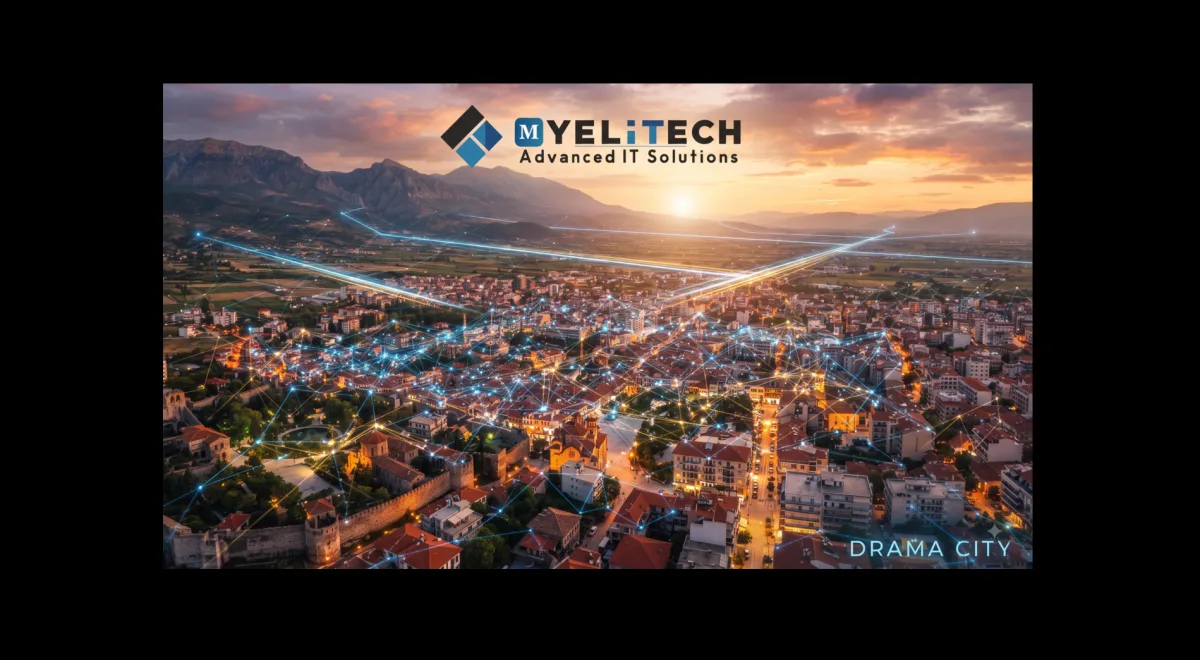
"So why don't you relocate to a major hub?"
It's a question every technology professional who chooses to work outside the big cities hears in one form or another — and it's not a Greek peculiarity: the same question is heard by the developer in a small German town, the designer on a Portuguese island, the consultant in a small city of the American heartland. Behind it lies an assumption that for decades seemed self-evident: that serious work happens where everything is concentrated.
After 25 years in this field — based in Drama, Greece, serving businesses across Eastern Macedonia on-site every day while supporting clients all over the country remotely — I have an answer that doesn't fit into a coffee-break conversation. So I'm writing it here. And it's not an answer against anyone; it's an answer about what changed in the world, and what our own regions can do with it.
Why concentration once made sense
Let's be fair to the old model: it had its logic. For decades, everywhere in the world, economic activity gathered in major hubs for entirely practical reasons. Fast infrastructure arrived there first. The large clients were there. Specialized talent moved there, because that's where the opportunities were — and the opportunities were there because that's where the talent was. A self-feeding cycle, equally true in London, Munich, Milan, and, naturally, in our own major urban centers.
If you wanted to do something ambitious with computers twenty years ago, moving toward such a hub was practically a one-way street. That wasn't an injustice — it was the geometry of the era.
The quiet collapse of an axiom
But that geometry changed — globally, and quietly. Nobody announced it with headlines; simply, piece by piece, the reasons that made concentration necessary stopped applying to anything digital.
The cloud means a business's "infrastructure" no longer has an address — it lives everywhere and nowhere, equally accessible from any point with a good connection. Remote work, once an exotic exception, has become normality worldwide: teams distributed across cities and continents, professionals living where they choose and working for clients they will never meet in person. And in our own country, fast connections have reached — and keep reaching — towns that only recently struggled with networks from another era, while digital government now serves you exactly the same, wherever you are.
I live this daily: a large part of my work happens remotely, for businesses all over Greece — and neither they nor I consider it remarkable anymore. Distance has stopped being a cost for anything digital. That's not a slogan; it's a description of my everyday reality for years now.
The gap that remains isn't technical
And yet, a gap exists. I see it every day. It just isn't where most people look for it.
It's no longer an infrastructure gap — it's an expectations gap. It's the phrase "we're in the provinces here, we don't need all that," which I hear from businesses that have in front of them exactly the same tools as any competitor of theirs, anywhere — and choose not to touch them. It's the local business treating its digital presence as a luxury "for the big players," at the very moment its own customers are already searching for it on Google. It's the self-fulfilling prophecy in its purest form: because we believe the region is behind, we behave in ways that keep it behind.
And there's the other side, which deserves honesty: the same openness that gives the local business access to the entire market also gives the entire market access to its customers. Competition long ago stopped being just the shop across the street — it comes from all over the country, and often from beyond it. Digitization, in other words, isn't a "do it or don't" dilemma; it's a "participate, or become merely someone else's market" dilemma.
The regional advantages nobody talks about
But here comes the part missing from the public conversation — because the region isn't merely "viable" as a base. In certain things, it holds advantages money can't buy.
First, relationships. In smaller markets, reputation is built and judged face to face, and trust travels by word of mouth with a speed and weight no advertising campaign can secure. A job done right — or wrong — is known across the whole market. It sounds terrifying; in practice it's the healthiest quality mechanism there is: here, you don't survive hiding behind a call center.
Second, proximity with substance. I can be at a client's premises in Drama, Serres, or Kavala within the hour when a problem requires physical presence — and the same day, remotely support a business at the other end of the country. Local physical presence and nationwide digital reach together: a combination of real, everyday value to the client.
Third, decision speed. In regional SMEs, the person who decides sits at the table — not three layers of hierarchy away. A project that elsewhere would need months of approvals starts here next week, as long as the owner is convinced it's worth it.
And fourth — the most personal one: the quality of life that allows people to stay in their hometown, or return to it, without sacrificing their professional ambitions. Every professional who builds something serious from where they're from is a small counterweight to decades of one-way internal migration — and proof to the next generation that it can be done.
Not a rivalry — an expansion
Let me make something clear, because this is often misunderstood: none of the above is against the major hubs. The big urban centers were, are, and will remain invaluable — things that need density and scale will keep happening there. What's new is not that the center loses; it's that the center has stopped being a precondition. The digital economy is not a zero-sum game where the region can only flourish if someone else loses — it's a pie that grows when more places and more people take part in creating it. A country that produces value in only two or three points on the map leaves most of its potential idle. A country that produces everywhere, wins everywhere.
What this means, practically, for a local business
If you run a business in regional Greece, the conclusion isn't sentimental — it's strategic. You have access to the same digital tools, the same markets, and the same possibilities as anyone, anywhere — plus the advantages of proximity and trust described above. But that access doesn't exploit itself. It takes a decision, it takes proper foundations — infrastructure, security, organized data, a credible digital presence — and it takes permanently retiring the word "provinces" from its role as an excuse.
Digital Greece will be built by those who decide their location is not a limit — wherever on the map they happen to be. For my part, that's exactly what I serve with MyeliTech from Drama: infrastructure, security, and digital foundations for the businesses of Eastern Macedonia & Thrace, with reach across all of Greece — and living proof that reach has no postal code.
If you're a business in the region and want to see what this means for your own case, let's talk.
Frequently asked questions
Yes — cloud, fast connections, digital government, and remote support are now available everywhere at the same quality. Today's gap is a matter of decision and foundations, not infrastructure.
On-site we cover Drama, Serres, and Kavala, while through remote support we serve businesses all over Greece.
The foundations: reliable infrastructure, security, organized data, and a proper digital presence. E-shops, remote service, and every digital channel are built on top of those.
For most everyday issues, yes — and often faster. Physical presence remains essential for hardware and installations, which is why the combination of both is the ideal model.
Related articles
UPS & Power Outages: The Silent Killer of Your Servers and Data
A two-second power cut can cost hours of recovery — or data that never comes back. What outages actually do to servers, NAS units and computers, what a UPS does (and does NOT do), and the three mistakes that cancel its protection.
Read more
10 Things No IT Technician Will Tell You
Twenty-five years in this field taught me things a client rarely hears — not because they're deliberately hidden, but because nobody has a reason to say them. Here are ten industry truths, said without a filter.
Read more
The Question I Get Asked Most Often
"Is it worth fixing, or should I replace it?" I hear it almost every week, for 25 years now — about computers, servers, networks, even entire infrastructures. And every time, I resist the temptation to give the short answer the person in front of me wants to hear. Here's why.
Read moreNeed help with this?
See how we can help with: Business IT Management
Ready to upgrade your infrastructure?
Let's talk about your business needs — no commitment.