GDPR & Personal Data Protection: What Every Small Business Should Know
GDPR isn't just for large organizations. See what it actually means for a small business, the most common mistakes, and how MyeliTech helps you comply without the stress.
Published
"GDPR is for banks and multinationals, not for us" is one of the most dangerous misconceptions we come across among small businesses. In reality, if you hold names, phone numbers, emails, or any other personal data of customers — even in a simple Excel file — GDPR applies to you directly.
What GDPR actually is
The General Data Protection Regulation (GDPR) is European legislation that sets out how personal data of individuals must be collected, stored, and protected. It's not about business size — it's about whether you process data belonging to customers, employees, or suppliers, which is something almost every business does daily.
The most common mistakes in small businesses
- Customer data on a personal computer with no encryption or password protection.
- Shared passwords across multiple employees, with no separate accounts.
- No deletion policy — former customers' data sitting around indefinitely for no reason.
- Sensitive data sent by email without encryption or recipient verification.
- No protected backup — if customer data is lost, there's no way to recover it or prove it was properly protected in the first place.
What's at risk if you don't comply
Beyond the legal risk of fines, there's a reputational risk too: a leak of customer data — names, phone numbers, payment details — can damage trust you've spent years building, far harder to recover than any fine.
Key compliance steps that actually make a difference
1. Mapping your data
Do you know exactly where your customer data lives? On which computer, which email, which system? Without this mapping, you can't properly protect it.
2. Access control
Every employee should have their own account, with access only to what they actually need for their job — not to every file in the business.
3. Two-factor authentication (2FA)
Even if a password gets stolen, 2FA adds a second layer of protection that blocks access without the user's physical device.
4. Regular, secure backups
Backup isn't just about business continuity — it's also part of responsible customer data management, ensuring data is never lost irreversibly.
5. A clear retention & deletion policy
Data you no longer need should be securely deleted, not piled up indefinitely "just in case."
GDPR isn't an obstacle — it's an investment in trust
A business that properly protects its customers' data isn't just complying with the law — it's sending a clear message of professionalism. In an era where customers increasingly ask "how do you protect my information," proper preparation becomes a competitive advantage, not just a bureaucratic obligation.
How MyeliTech helps
MyeliTech's Data Protection service covers data protection, backups, 2FA, and GDPR compliance, so you can operate without worry — without needing to become a data protection law expert yourself.
Request a compliance assessment via myelitech.gr and see where your business currently stands.
Frequently asked questions
Yes, GDPR has no minimum record threshold; it applies to every business that processes personal data.
No, it takes a combination of measures: access control, encryption, backup, and a clear data retention policy.
It's two-factor authentication — a second verification step beyond the password, which blocks unauthorized access even if the password is stolen.
Yes, we start with an assessment of your current situation before recommending any changes.
Related articles
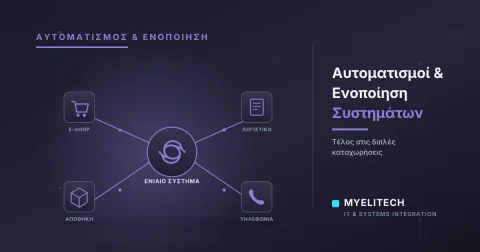
Automation & System Integration: The End of Duplicate Data Entry
Accounting, warehouse, e-shop, phones: when every system lives in its own bubble, you lose hours daily to duplicate data entry. Here's how system integration fixes it.
Read more
Digital Transformation for SMEs: How an Infrastructure Audit Drives Measurable Results
Digital transformation doesn't have to mean risk or downtime. See how a proper infrastructure audit lays the groundwork for safe, gradual change with visible results.
Read more
Digital Transformation: Where a Business That Wants to Change Should Start
Want to "go digital" but don't know where to start? You don't need a huge budget or to change everything at once. Here's how it's actually done, step by step.
Read moreNeed help with this?
See how we can help with: Digital Transformation, Audit & Consulting
Ready to upgrade your infrastructure?
Let's talk about your business needs — no commitment.